The ScienceBehind the Wand
The research that brought the Reset Wand to life.
How your body listens
Touch sends a signal.
Your brain listens.
Your nervous system is always sorting through messages from your body. Gentle pressure and slow massage add calm, steady signals to that mix.
Touch and pressureDiscomfort signals
The gate idea. In 1965, researchers Ronald Melzack and Patrick Wall proposed that the spinal cord works a little like a gate for signals traveling up to the brain. Touch and pressure travel on fast nerve fibers and may help close that gate, so other signals feel less intense.1
Why it matters here. It is one reason gentle pressure and massage have such a long history in wellness routines. Research reviews on massage continue to look at how touch supports relaxation and comfort.2
What researchers study
Five areas of research.
One wand.
Each practice inside the Reset Wand has its own body of research. The numbers match the research library further down.
- 01
Auricular acupressure
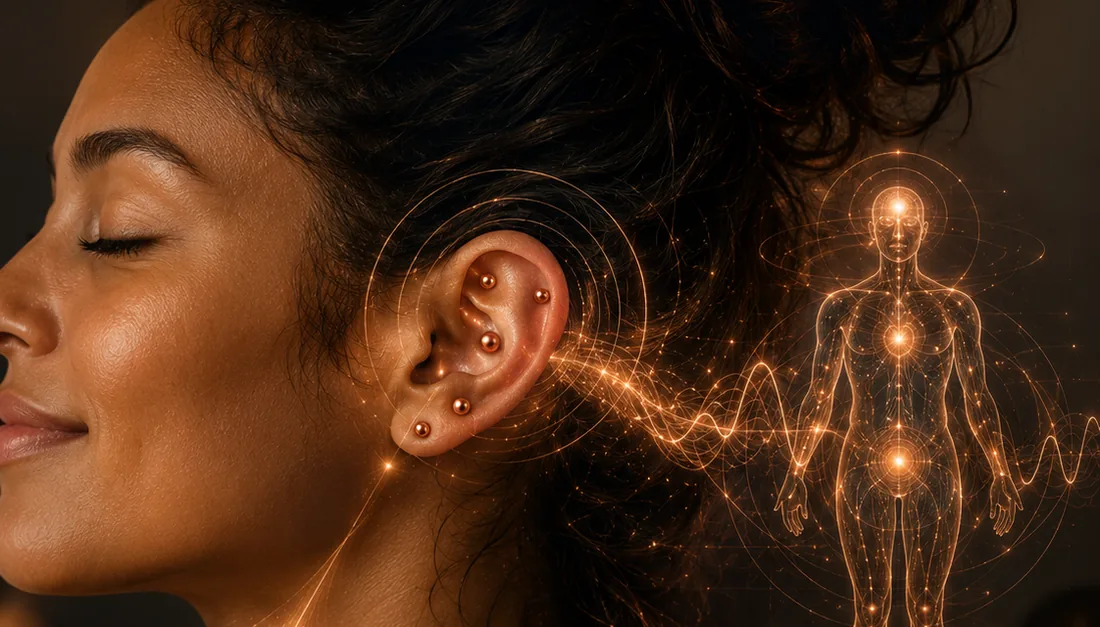
Gentle pressure on mapped points of the outer ear, with no needles. Reviews of clinical trials have looked at ear acupressure for relaxation and sleep quality, and ear protocols like NADA are used in behavioral health programs alongside standard care. Reviewers call the results promising and ask for larger, higher quality trials.
Sources34 - 02
The ear and the vagus nerve
The vagus nerve is a main line of communication between the brain and body. One of its branches reaches the skin of the outer ear, in areas like the concha, and scientists are mapping it closely. The Reset Wand uses gentle touch and pressure there. It is not an electrical stimulation device.
Source5 - 03
Touch and massage
Touch and pressure are among the most studied wellness practices there are. Research reviews on massage look at relaxation, comfort and mood, and the gate idea above helps explain why gentle pressure feels the way it does.
Sources12 - 04
Slow breathing
Slowing your breath to around six breaths a minute is linked in studies with changes in heart rate variability, a marker of the body's rest and digest activity. That is why slow breaths are part of every reset.
Source6 - 05
Low-frequency sound
Low-frequency sound, roughly 40 to 120 Hz, has been studied for relaxation and comfort. One clinical study tested 40 Hz sound with a small group of participants. Researchers say larger trials are still needed.
Source7
Our approach
Honest about
the research.
Built on studied practices
Every part of the Reset Wand is based on a practice researchers have studied on its own: ear acupressure, touch, breathing and sound.
Plain words
We explain each study in everyday language, and we say so when the research is still limited.
We keep learning
New research comes out every year. As it does, we will keep this page current.
The studies on this page look at the practices themselves. The Reset Wand brings them together in one simple tool.
Research library
Read it
for yourself.
The studies and reviews mentioned on this page, in the order they appear.
- 1
- 2
- 3Auricular acupressureEffectiveness of applying auricular acupressure to treat insomnia: a systematic review and meta-analysisRead the study
- 4Ear protocolsThe National Acupuncture Detoxification Association protocol, auricular acupuncture to support patients with substance abuse and behavioral health disorders: current perspectivesRead the study
- 5The vagus nerve and the earThe anatomical basis for transcutaneous auricular vagus nerve stimulationRead the study
- 6Slow breathingHow breath-control can change your life: a systematic review on psycho-physiological correlates of slow breathingRead the study
- 7Low-frequency soundThe effect of low-frequency sound stimulation on patients with fibromyalgia: a clinical studyRead the study
Next steps
See the science
in your hand.
Meet the tool that brings these practices together, see how the app will guide you, and sign up below to hear first when the Reset Wand launches.
The statements regarding the Reset Wand have not been evaluated by the U.S. Food and Drug Administration. The Reset Wand is not intended to diagnose, treat, cure, or prevent any disease.